

Sustainable procurement in facilities management is no longer viewed as an added benefit. It is central to risk management, ESG reporting and value for money across multi-site estates. Yet most specifications still rely on generic claims like eco-friendly or natural without the data procurement teams need for audits and tenders.
This guide shows how to build a compliant, verifiable specification for professional cleaning products using lifecycle analysis, transparent carbon data and Scope 4 attribution. It also outlines due diligence steps, pilot-to-rollout workflows and the role of refill systems and dosing in cutting single-use plastics, spend and logistics emissions.
If you manage procurement or FM, use this as a practical checklist you can lift straight into your next tender.
Define what counts as eco-friendly in your specification

Avoid vague labels. Set a measurable definition up front and use it consistently.
- Lifecycle-backed: every shortlisted product must have a product-level lifecycle analysis (LCA) covering materials, manufacturing, transport, use and end-of-life.
- Verified claims: where applicable, third-party certifications should substantiate environmental performance; require certificate numbers and scope.
- Safer chemistry in use: prioritise products designed to minimise aquatic toxicity and reduce hazardous classification at use dilution, with Safety Data Sheets (SDS) and Classification, Labelling and Packaging (CLP) information provided.
- Packaging and format: concentrates, bulk containers, or sachets that enable onsite dilution and reduce single-use plastics. Require evidence of plastic reduction versus the incumbent.
- Performance parity: products must meet or exceed cleaning efficacy of current stock in controlled pilots with agreed soils and surfaces, and with dosing instructions documented.
This definition answers two common questions in a professional context. What are eco-friendly products? They are products designed to reduce environmental impact across the full lifecycle with verified data and safer use profiles. What is a sustainable cleaning product? It is one that pairs proven performance with measurable, third-party-substantiated reductions in environmental impact, supported by refill or bulk systems and transparent reporting.
For a wide view of professional-grade options that meet these criteria, see our selection of sustainable cleaning products and related green cleaning solutions at Lime.
Evaluate LCA and interpret carbon data correctly
A credible LCA anchors your decision. Request a one-page summary and a technical appendix for each product.
- Materials: origin of key feedstocks, renewable content, hazardous substances avoided, and packaging composition. Look for reductions in virgin plastic through concentrates and returnable containers.
- Manufacturing: energy sources, process efficiencies and waste treatment. Prefer suppliers that disclose renewable energy percentages at plant level.
- Transport: typical shipment weights and modes. Concentrates and sachets usually cut freight emissions per functional use because water is added onsite.
- Use phase: dosage per task, water temperature required, and in-use classification. Dosing control is often the largest lever for both impact and cost.
- End-of-life: recyclability of primary and secondary packaging, take-back schemes and expected disposal routes.
When interpreting the carbon footprint, compare like for like at a functional unit level, for example kilograms of CO2e per 1,000 restroom cleans at the specified dilution. Do not compare per litre where one product is a concentrate and another is ready to use. Normalise assumptions for dilution, trigger bottle refill rates and dispenser settings.
Attribute Scope 4 savings against the incumbent
Scope 4 is an attribution category for avoided emissions achieved by choosing lower-impact products and formats. In specifications, require suppliers to:
- Provide a counterfactual model that reflects your incumbent products, formats and logistics patterns.
- Use functional-unit comparisons that match your cleaning tasks across sites.
- Disclose calculation boundaries and data sources.
- Present results as a range with sensitivity analysis for dosing variance and order consolidation frequency.
Your team can then claim institution-wide Scope 4 savings in ESG reports and tenders, with the methodology on file for auditors.
Lime provides free monthly visual ESG reporting that tracks product- and category-level LCAs and organisation-wide Scope 4 savings, making this attribution straightforward to evidence across multi-site estates.
Use format to cut plastics, spend and freight emissions

Refill, bulk and dose-controlled formats typically deliver the fastest, most defensible reductions.
- Concentrates and sachets: shift from ready-to-use to concentrates with calibrated dosing or water-soluble sachets to reduce plastic and transported water. Document the reduction in bottles per 1,000 cleans.
- Bulk containers: specify larger container sizes where manual handling policies allow, combined with wall-mounted or portable dispensers.
- Standardised dosing: set site-level dose settings, colour-coded bottles and laminated task cards. Record verified dose per task during pilots to keep savings auditable.
- Order consolidation: require suppliers to support fuller, less frequent orders and provide emissions factors for transport. Choose carriers that invest in lower-emission fleets.
If you are standardising washrooms, consider high-capacity paper that reduces changeovers and waste, alongside compliant washroom cleaning products. Where helpful, explore sustainable bathroom products and related washroom supplies to align format choice with traffic patterns.
Supplier due diligence that stands up in audits
Include the following documentation requirements in your RFP and contract.
- Certifications: Where applicable, with scope and validity dates. Clarify which lines are certified and which are not.
- SDS and CLP: current SDS for all concentrates and in-use solutions, plus CLP labels and workplace instruction sheets.
- Supply chain transparency: country of manufacture, major raw material sources, and renewable energy use at plants.
- LCA and carbon: product-level reports with boundaries, data quality statements and functional-unit footprints.
- ESG services: monthly visual ESG reporting with product-level and category rollups, Scope 4 attribution and recommendations for optimisation.
- Implementation support: sample packs, dosing and dispenser compatibility checks, pilot templates and training materials.
Pilot-to-rollout workflow for multi-site estates
Treat the transition as an operational change program.
- Scoping: map current products, tasks, volumes and formats by site. Define functional units and pilot success metrics, including performance, cost per task, plastic reduction and CO2e per task.
- Pilot: run controlled trials on representative sites for 4 to 6 weeks. Capture dosing, efficacy, user feedback, and any safety observations. Document training delivered and signage used.
- Verification: compare pilot results with the counterfactual model. Stress test carbon and plastic savings with sensitivity analysis for under and overdosing.
- Standardise: finalise the product list, dispenser settings, bottle labels and task cards. Lock functional units and agree reporting cadence.
- Rollout: sequence sites, align deliveries, train supervisors, and monitor early-use variance.
- Report: integrate pilot baselines into monthly ESG reports for board, client and tender use.
Lime’s pilot support, next-day UK delivery and live data briefings help teams move from pilot to rollout on agreed timelines while maintaining compliance.
Monthly visual ESG reporting that makes audits easier
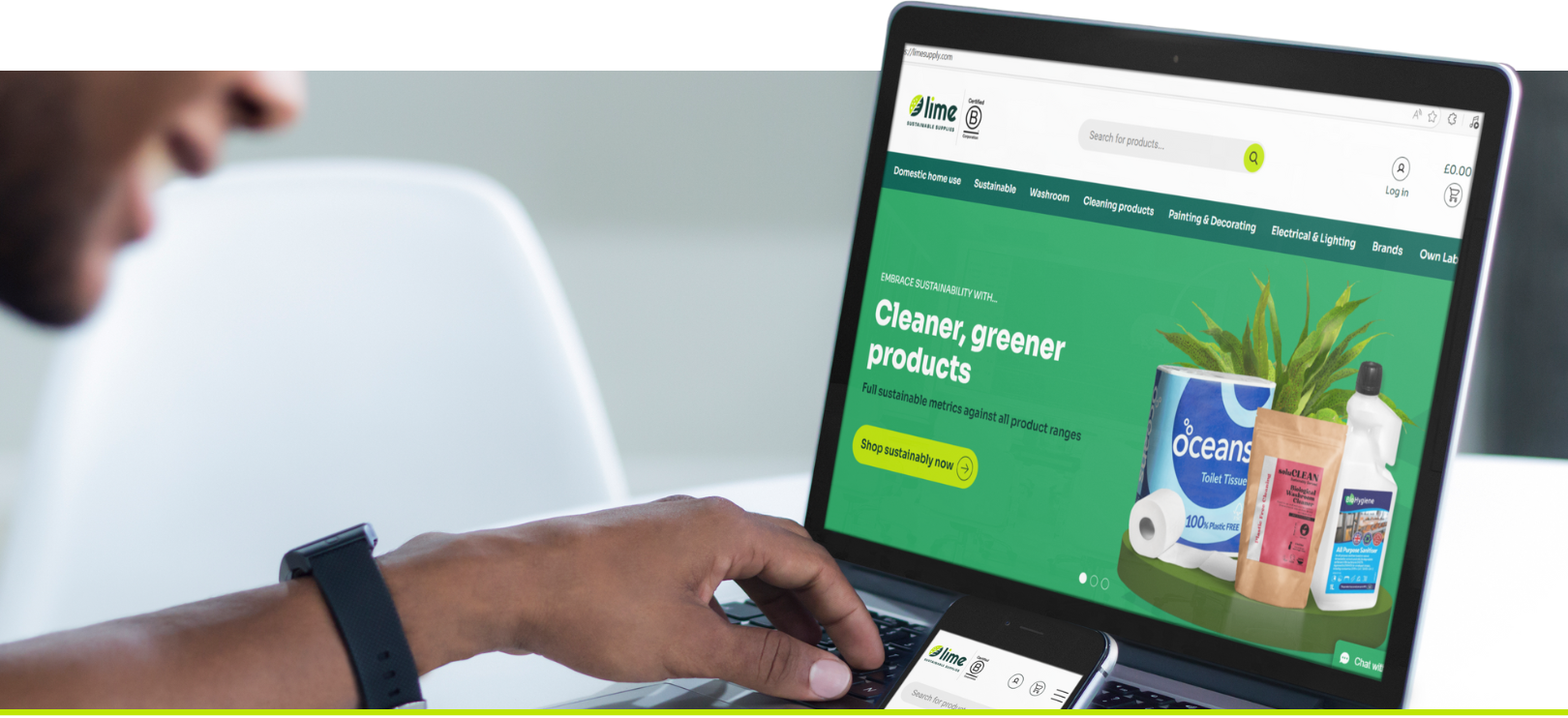
For UK public procurement and common FM frameworks, you need clear evidence that environmental claims are material and measurable. Monthly ESG reports should show:
- Category and product LCAs with trend lines for CO2e and plastic reduction.
- Institution-wide Scope 4 savings with methodology and assumptions.
- Opportunities for further reductions, for example switching remaining ready-to-use lines or consolidating orders.
- Exportable charts and data tables suitable for tender appendices and client reviews.
This approach aligns with compliance-first expectations and equips your team to answer challenge questions quickly.
Quick FAQ for procurement and FM
- What are eco-friendly products? In this context, they are cleaning lines with lifecycle-backed evidence of reduced impact, safer in-use profiles, and formats that cut packaging and transport emissions.
- What is a sustainable cleaning product? It is a product that maintains required hygiene performance while delivering measurable, verified reductions across its lifecycle, supported by refill or bulk formats and credible reporting.
- Are eco-friendly cleaning products effective? Yes, when specified and dosed correctly. Require pilot verification against agreed soils, surfaces and methods to confirm performance parity or better.
- How do you know if a cleaning product is eco-friendly? Look for product-level LCAs, recognised certifications where applicable, transparent SDS/CLP documentation, and monthly ESG reporting that attributes Scope 4 savings against your incumbent.
Next steps
If you are preparing a tender or refreshing a framework lot, shortlist suppliers that can provide transparent LCA data, dosing-controlled formats and auditable Scope 4 attribution. To explore compliant options and implementation support, review our eco cleaning supplies and sustainable cleaning supplies categories, or contact us for sample packs, pilot templates and a live data briefing.